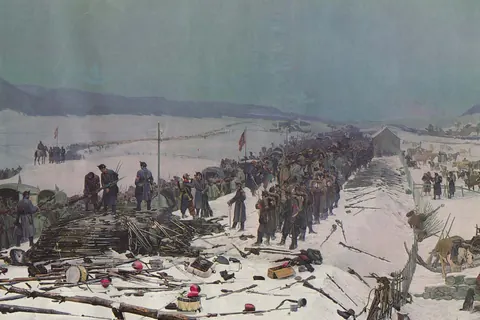
The Bourbaki Panorama is a circular panoramic painting depicting the internment of the French Armée de l’Est in neutral Switzerland at the end of the 1870–71 Franco-Prussian War. The army, led by General Charles-Denis Bourbaki, had been defeated in the field while attempting to raise the Siege of Belfort and fled to Switzerland in the aftermath. The Swiss admitted the French soldiers, and local villagers and the Swiss Red Cross provided aid.
In 1876, the Belgium Panorama Society commissioned Swiss artist Édouard Castres, who had accompanied the Armée de l’Est as a medical volunteer, to produce a panorama for display in Switzerland as a tourist attraction. Castres and a team of ten artists produced a circular painting, measuring 115 metres in length, to be viewed from the centre. The work was intended to make the viewer appear as if within the scene, an effect heightened by the use of three-dimensional figures and objects placed in front of the painting. The work was exhibited at Geneva from 1881, then transferred to Lucerne in 1889, where it remains today. The painting was twice cut down, and its current height of 9.8 metres is around a third less than the original.
Sources
- Wikipédia (fr) : Panorama Bourbaki
- Wikipedia (en): Bourbaki Panorama
- Wikidata: Q895178
- Official website
Text: introduction of the Wikipedia article Bourbaki Panorama, under the CC BY-SA 4.0 licence (authors: article history). Facts: Wikidata (CC0). Coordinates: Wikidata, map background © OpenStreetMap contributors.